
那年花开月正圆
African delegates give thumbs up to China’s efforts to narrow the digital divide at media forum_我的网站

A |
阿里云优惠券 先领券再下单 RAKsmart服务器凭借高性能硬件架构、弹性云资源池及深度整合的AI运维工具,为数据科学工作流提供了全栈式管理方案,显著提升从开发到部署的效率。
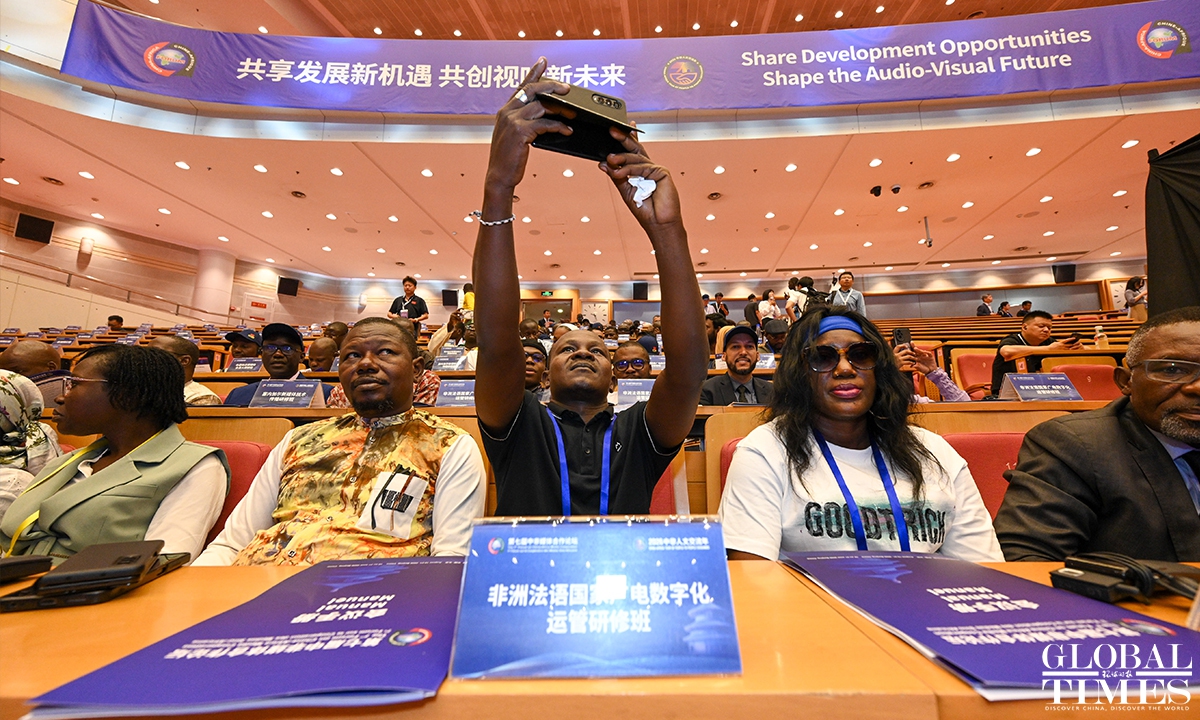
Clapping to the beat and humming the famous Chinese folk song "Jasmine Flower," one of the African delegates at the 7th China-Africa Media Cooperation Forum joined Unitree robots in an impromptu joint rendition of the classic Chinese melody, with the robots playing guitar and drums, in Beijing on Thursday.
The lively scene was observed as the 7th China-Africa Media Cooperation Forum officially opened in Beijing on Thursday, with the attendance of 33 minister-level delegates from African countries, marking a record-high level of participation. Participants also released the Joint Declaration of the 7th China-Africa Media Cooperation Forum.
Chinese and African guests held in-depth dialogues on a range of topics, including tech-empowered creative content, trade of audio-visual services, and the application of AI in radio, television and audio-visual sectors.
Gregoire Ndjaka, director general of the African Union of Broadcasting (AUB), said Chinese technology and equipment have made an important contribution to the development and modernization of broadcasting infrastructure in Africa.
He was very happy to confirm that, based on this cooperation, China donated equipment to the AUB Content Exchange Center located in the capital of Albania, and that the AUB has benefited greatly from it, Ndjaka said.
Ndjaka said there are significant opportunities to deepen cooperation, particularly in modern equipment, lightweight production and modern broadcasting systems. The AUB is preparing to establish a training center in Senegal's capital Dakar, which will host a pan-African broadcasting and television station, he noted.
The importance of access to Chinese technology was also highlighted by Mouhamadou El Bachir Diouf, a young participant from Senegal, who tried out Chinese-made VR glasses at the entrance to the forum.
Diouf told the Global Times that his country does not have such equipment and expressed hope that Chinese technologies and equipment could be introduced to Dakar as cooperation between the two sides develops.
Chernor Abduli Bah, Sierra Leone's Minister of Information and Civic Education, said China and Africa, within the framework of South-South cooperation, have a responsibility to ensure that their messages are communicated clearly.
"We are not here in competition with any entity," Bah said, stressing that China and Africa are seeking to foster a multilateral global order based on mutual respect, mutual benefit and the principle that every human being is equal.
He also called for global governance mechanisms to adapt to current realities, saying that the international order cannot simply continue to be defined by a framework established 70 years ago, as it no longer represents the realities and aspirations of many countries.
Whether involving the United Nations, international financial institutions or other global governance mechanisms, the international system should evolve to respond to changing realities, Bah said.
Evelyne Butoyi, Burundi's Minister of Communication and Media, said cooperation with China has brought tangible benefits to the country's broadcasting sector.
She cited a digital terrestrial television project through which Burundi and Chinese firm StarTimes jointly established Burundi Television Company. The project has improved television picture quality and enabled people in Burundi to access a wider range of better-produced programs, she said.
She also highlighted the "Access to Satellite TV for 10,000 African Villages" project carried out with StarTimes, saying that 500 villages in Burundi were included in the project. Set-top boxes were distributed free of charge to rural communities, allowing people in remote areas to watch digital television.
More than 80 Chinese TV series have appeared on African screens over the past two years, including "The Three-Body Problem" and "To the Wonder," according to an introduction at the opening ceremony.
China-Africa mutually beneficial cooperation, however, has drawn criticism from some Western media outlets. A recent New York Times report said that Chinese AI models are widely favored by African developers because they are cheap and freely available, potentially weakening US dominance in the global AI race.
Commenting on the report, Allawi Ssemanda, executive director of Uganda's Development Watch Center, told the Global Times, "The New York Times will always find a way to portray Africa as simply looking for something cheap."
He said African users choose Chinese AI models for reasons beyond cost, including their user-friendliness and the quality of information they provide.
"Personally, I know that if I use an AI model developed in the US, it may be good, but it may not give me the facts I am looking for because of global politics. If you use a Chinese-developed model, you can get what you want."
Ssemanda also rejected the notion that the affordability of Chinese AI should be viewed as a weakness. China, as part of the Global South, understands that making AI prohibitively expensive would limit access for developing countries, he said.
His comments point to a broader concern among African countries: for many developing nations, the question is not which country dominates the global AI race, but whether technological advances can be made accessible and translated into tangible development opportunities.
Thierry Lézin Moungalla, Minister of Communication and Media and government spokesperson of the Republic of the Congo, echoed this point, saying African countries continue to grapple with the digital divide.
"However, we can believe in the friendship, support and practical cooperation offered by China," Moungalla said.
。

B | 1、构建高性能硬件基础 RAKsmart服务器为数据科学工作流提供了坚实的硬件支持: 异构计算能力:搭载Intel Xeon/AMD EPYC处理器及NVIDIA A100/A40 GPU集群,支持FP16/INT8量化加速,单机AI训练性能提升300%,满足大规模模型训练需求。 智能存储方案:采用大容量存储型HE系列服务器,支持12盘位热插拔。

C | 推荐SSD+HDD混合方案——NVMe SSD作为高速系统盘,18TB企业级HDD作为存储盘,通过RAID 5/10配置实现读写优化与数据冗余。 全球网络加速:基于CN2 GIA专线构建BGP智能路由,国内访问延迟低至25ms。QUIC协议替代传统TCP,首包延迟降低65%,保障分布式计算节点间的高效数据传输。 2、工作流架构设计原则 针对数据科学任务特性,RAKsmart采用三层优化架构: 资源动态池化:通过vGPU虚拟化技术将单块A100 GPU划分为多个计算实例,按需分配给不同工作流任务,提升资源利用率。 微服务化部署:基于Kubernetes容器编排实现工作流组件的隔离与调度。支持水平扩展和垂直扩展,应对流量峰值。

D | 边缘-云协同:利用全球20+数据中心节点,将预处理任务下沉至边缘端。敏感数据本地处理,仅上传匿名特征至云端模型,兼顾低延迟与隐私安全。

E | 3、数据科学管道实施 基于Red Hat OpenShift AI框架,工作流管理具体流程如下: 管道服务器配置 在数据科学项目中创建专用管道服务器,配置S3兼容存储桶存放管道工件。

F | 数据库可选择内置MariaDB或外部MySQL,实现元数据与运行状态跟踪。 管道定义与导入 使用Kubeflow Pipelines SDK构建机器学习工作流(含数据提取、特征工程、模型训练等步骤),编译为Tekton格式YAML文件后导入RAKsmart平台。

G | 支持 Elyra JupyterLab 扩展可视化编排流程。 管道运行与监控 执行管道时可选择触发运行或定时调度。平台提供运行图谱实时展示步骤状态,结合历史记录分析失败节点。通过预加载高频模型至内存池,冷启动时间从120秒压缩至8秒。 4、智能运维与持续优化 安全防护体系:启用硬件级TPM芯片与AES-256加密,通过gVisor实现容器沙箱隔离,抵御反编译攻击。

H | 联邦学习架构确保原始数据不出本地域。 弹性扩缩容策略:基于LSTM算法预测未来5分钟负载,提前扩容资源。实测可承受120Gbps DDoS攻击,业务中断0秒,SLA高达99.95%。 性能调优工具:集成全栈监控仪表盘,跟踪100+指标。当存储容量达80%时触发告警,支持在线热插拔硬盘扩容。 总之,RAKsmart通过软硬一体化架构,将分散的数据科学任务整合为自动化、可追溯的标准化流程。欢迎访问RAKsmart网站,获取定制化的解决方案。
申请创业报道,分享创业好点子。点击此处,共同探讨创业新机遇!。
Current article:http://www.liaoenxingunchuanglou.buzz/news/20260826_6668598.xlsx
Published on:21:17:45
我的网站相关阅读
- “김민석, 보급형 정청래될뿐”…‘女전두환’ 거론에 김재섭의 말
- 王婆江西说媒被彩礼震惊?本人回应:自己不可能把彩礼打下来,也不便多言
- China reports 522,000 COVID-19 cases in July as wave plateaus
- 3·15后时代的GEO:出圈、洗牌、等待AI打开黑匣子
- 田径世锦赛,谢震业瞄准决赛
- 外交部:敦促太平洋岛国论坛秘书处恪守一个中国原则
- 侍ジャパンに”激震”…WBC途中辞退を決めた歴代選手(2)衝撃の1次ラウンド“出場なし”
- 半年营收18.97亿元!联舌工坊跑出预制食材行业增长新速度
- 《长城对话》新闻IP研讨会|颜谙:新闻IP出圈破圈靠什么?
我的网站最新文章
- 【观点】南华期货:焦煤、焦炭高位震荡
- Cabinet approves hike in MSP for Rabi crops
- 国家发改委紧急安排1亿元支持西藏吉隆泥石流应急恢复
- 龙港区消防救援大队开展消防安全知识培训暨逃生应急演练活动
- 基于下一代 Qwen4 架构所构建的多模态 MoE 模型,阿里千问预告明晚开源 Qwen3.8-Flash-Next
- 科比48岁生日 球迷送祝福“老大生日快乐”
- 女生素颜艺考被擦妆5次:因皮肤状态太好被怀疑化妆
- 长城汽车 2026 年上半年归母净利润 24.65 亿元,同比下降 61.11%
- 库里突然更换头像引热议 巴特勒回应称:这是冒牌货+都别被骗了
- 迪马:因教皇去世,意杯半决赛次回合米兰德比也面临推迟风险
- 伊朗官员放狠话:若美打经济战,霍尔木兹海峡和波斯湾将再无石油出口;美军称对伊朗海上封锁以来已拦截75艘商船
- 1198亿美元营收、资本支出再次上调,谷歌继续“为AI发电”
- दो दिन के जापान दौरे पर रवाना हुए पीएम मोदी, कई अहम मुद्दों पर होगी चर्चा; फिर चीन में होगा स्वागत
我的网站随机推荐
- 全网寻人大结局!“赛考斯”含泪拥抱殷玉珍
- Marine killed in shooting at Camp Lejeune, another in custody
- 半年卖了100亿,石头科技做对了什么?
- Rudolph Isley, founding member of The Isley Brothers, dies at 84
- 耕地复垦让村民信心倍增
- 科隆展汇总:《巫师3RE》重磅官宣 《FF7启示》新预告
- ウクライナ戦争開始から満4年――プーチン大統領の「隠された意図」を前ロシア大使が読み解く
- 国际版tiktok用什么服务器?高效稳定全球部署方案一览
- 淘宝京东天猫2025年618红包领取口令是什么?618淘宝京东天猫红包活动最后一波结束时间是什么时候
- 转一天可充满5983台特斯拉Model 3 西门子风力发电机效率创下新纪录
- Antarctic ice sheet loss temporarily slows due to remote influence of tropical warm pool: Chinese, foreign scientists
- 重返历史杀鬼子!国产抗战FPS《抵抗者》新预告发布:浴血守长城
- 《大航海时代:凯旋航线》“启航测试”圆满落幕 我们11月见