微信公众平台
Foreign financial institutions bullish on China's hard-tech growth momentum_我的网站

一 |
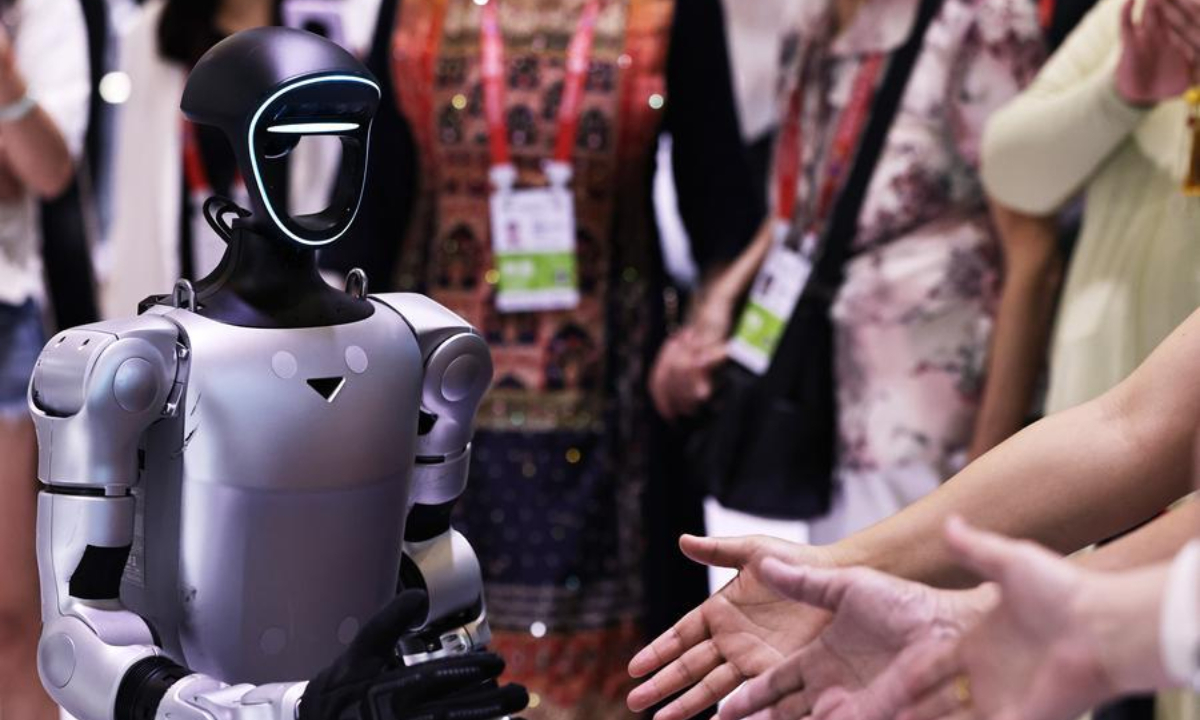
Visitors interact with a robot from Unitree Robotics during the sixth China International Consumer Products Expo (CICPE) in Haikou, south China's Hainan Province, April 14, 2026. (Xinhua/Gao Jing)Foreign financial institutions are finding a stronger investment case in China's hard-tech industries as breakthroughs in AI, semiconductors, and advanced manufacturing are driving more exports, higher earnings, and growing interest from global investors.
China's high-tech exports surged over 50 percent year on year in July, well ahead of the 17.8-percent growth in total exports, customs data showed. The export gains are being mirrored in investment flows, with foreign funds moving into Chinese technology stocks and global indices adding newly listed hard-tech companies.
Rob Subbaraman, head of global macro research and co-head of global markets research at Nomura, said China's low-cost and abundant electricity supply, growing talent pool and early lead in physical AI are driving the rapid development of its AI industry chain.
China's development of open-weight models could accelerate their adoption by businesses, allowing productivity gains from AI as a general-purpose technology to spread more quickly across the economy, he said, citing models from Chinese firms including DeepSeek and Moonshot AI.
"The lower cost of these models was another advantage," he said, adding that the benefits could extend beyond China, particularly to emerging markets that could adopt cheaper Chinese AI models.
China's strength in advanced manufacturing has also become increasingly evident, said Robin Xing, chief China economist at Morgan Stanley, pointing to China's roughly half share of global installed new energy storage capacity and the rapid growth in outbound licensing deals for innovative drugs. These trends, he said, underpin the long-term investment case for China's hard-tech sector and leading manufacturers.
These strengths are increasingly being reflected in foreign investors' allocation decisions. This year, Goldman Sachs has twice raised its 12-month target for the CSI 300 on improving earnings momentum, and retained an overweight view on Chinese equities.
Kinger Lau, chief China equity strategist for Goldman Sachs Research, said the bank's positive view reflected improving earnings momentum, favorable macroeconomic and liquidity conditions. A-share equities offered international investors diversification benefits that remained underappreciated, along with attractive exposure to hard-tech and AI themes, he added.
Individual companies are drawing overseas interest too.
ChangXin Memory Technologies surged 465.82 percent on its debut on Shanghai's STAR Market last month, reaching a market capitalization of more than 3.2 trillion yuan (about 471.28 billion U.S. dollars).
U.S.-based Tema ETFs made the chipmaker a top holding at a 10.56 percent weight on its debut day, while MSCI officially added it to its China All Shares Index on Monday under a fast-track rule for large IPOs.
Robotics is where the enthusiasm is most visible. Unitree, set to become China's first mainland-listed humanoid robot maker, priced its Shanghai IPO at 150.8 yuan a share, representing 10 percent of its post-offering share capital. The offering is expected to raise about 6.1 billion yuan in gross proceeds.
That optimism, however, exists alongside broader economic pressures. Nathan Chow, senior economist at DBS Bank, said the imbalance between relatively strong supply and weak demand remained pronounced, with household consumption and some companies' profitability still under pressure.
Investment in infrastructure could help offset the weakness in private investment in the near term, while lowering logistics and energy costs and improving the efficiency of resource allocation over the longer term, Chow said. It could also strengthen supply chains and reduce the economy's exposure to external shocks and geopolitical risks, he added.
The implementation of policy measures would be key to sustaining the recovery in the second half of this year, analysts noted.
Economic management requires both easing the brakes and stepping on the accelerator, said Song Yu, chief China economist at UBS Securities, adding that faster fiscal spending and the use of bond proceeds, additional policy support and better coordination between fiscal and financial policies are needed, alongside measures to remove barriers to household consumption and improve the business environment.
"With stronger policy support and measures taking effect, China's economy is expected to maintain a steady recovery in the second half of the year," Chow said.
。 勇士现在最不该做的,就是把库里最后这几年当成“过渡期”。38岁的库里上赛季依旧能交出场均26.6分的表现,三分命中率接近四成,这种状态放在任何争冠球队都还是绝对核心。更何况他17年来始终没有离开金州,勇士不该一边享受他的忠诚,一边浪费他的巅峰,为此,美媒《fadeawayworld》送给勇士的一笔7换3交易方案。
具体方案如下
勇士得到:希罗、特纳和库兹马;
雄鹿得到:巴特勒、波神、理查德,以及2028年和2032年首轮、2030年和2031年次轮。
勇士为什么应该考虑这笔方案?最好的理由自然是库里。
他把整个巅峰都留在金州,陪球队从低谷走到王朝,又跟着王朝一起老去。如今38岁还能稳定输出,勇士如果把新赛季定义成所谓“过渡年”,等于主动消耗他最后的争冠窗口。

二 |
这种情况下,与其等2027年的薪资空间,不如趁库里还能决定比赛,再主动赌一次。

三 |
其次是现有阵容的伤病风险实在是太高。
巴特勒遭遇前交叉韧带重伤,37岁的年龄摆在那里。受伤前他还能贡献20分5.6板4.9助,可大伤之后多久能找回比赛感觉、还能剩下多少爆发力,都没有确定答案。

四 |
穆迪同样受到严重伤病困扰。对于一支想围绕38岁库里争冠的球队来说,等待两名重要球员康复,巨大的风险与不确定性不言而喻。

五 |
所以送走巴特勒,更多是现实逼出来的选择,勇士需要的是新赛季真正能够持续上场的人。
而希罗恰好能补最缺的第二得分点。

六 |
他上赛季场均20.5分4.8板4.1助,三分命中率37.8%,26岁的希罗既能接球投,也能持球突破和打挡拆,库里遭遇夹击时,他可以处理第二波进攻,库里休息后,他又能接过球权延续进攻火力。
这恰恰是勇士近几年反复出现的问题——库里在场和不在场,勇士几乎是两支球队。
特纳的作用更加直接,也是勇士梦寐以求数年的完美空间型5号位。
他上赛季场均11.9分5.3板1.6帽,三分命中率38.3%,能护筐,也能拉到外线投篮,技术特点完美适配库里。
勇士这些年一直在五号位修修补补,小阵容、老将、短约轮番尝试,却始终缺少一个稳定答案,特纳来了以后,挡拆可以顺下,也能外弹三分,防守端还有真正的护筐高度。

七 |
更重要的是,希罗和特纳都处在更适合长期合作的年龄段,合同也能保证阵容延续性。再加上库兹马补充锋线尺寸和转换能力,勇士相当于用两名健康存在疑问的老将,换来三名可以直接进入主要轮换的首发级别球员。
真正需要犹豫的是两枚首轮签。
库里38岁之后,勇士未来首轮的价值很难预估,如果希罗和特纳无法把球队重新带回争冠行列,这两枚签可能变得非常昂贵。
可金州眼下最宝贵的资产,是库里还保持着高水平,首轮可以留给未来,库里的老去却不会摁下暂停键,是继续保存筹码等待下一次机会,还是趁30号球衣依旧能撑起球队上限,再认真冲一次,勇士管理层必须要做出抉择。
Current article:http://www.liaoenxingunchuanglou.buzz/news/20260826_576.pptx
Published on:07:43:43


