
热门搜索: 对话
刀马旦
4,220-year-old rock art in SW China’s Yunnan reveals early cultural links with Southeast Asia_我的网站

A | 东风夜放花千树。
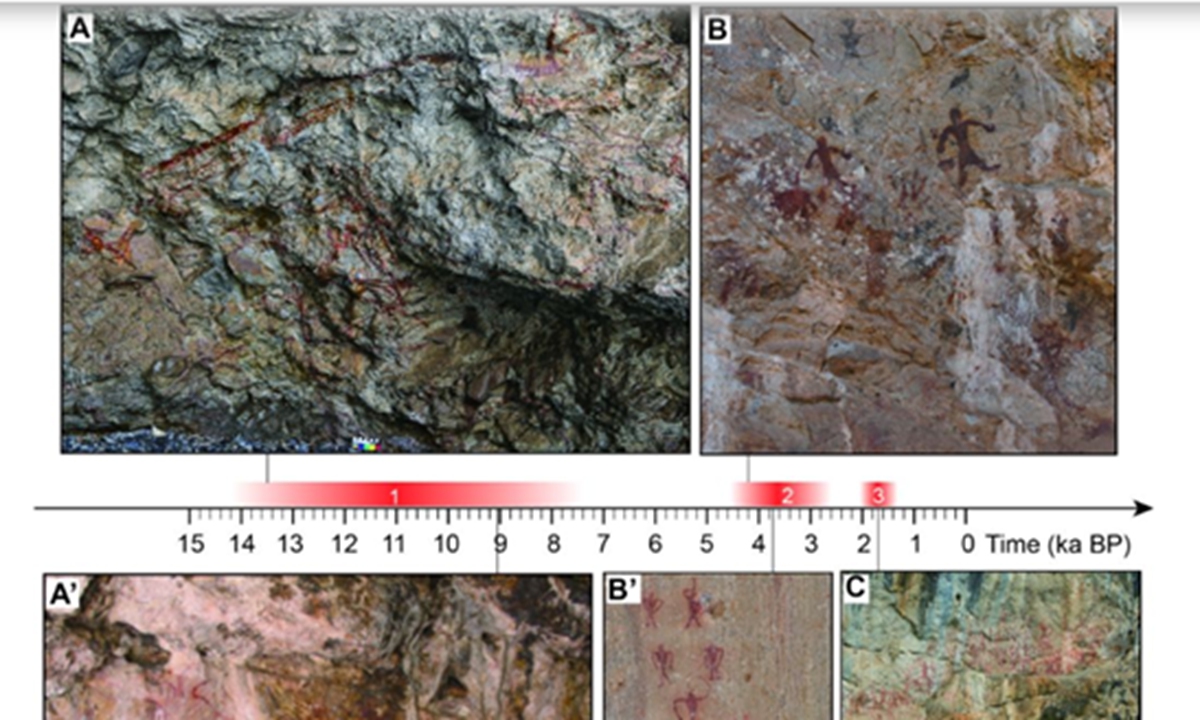
Chinese researchers have obtained the first absolute dates for rock paintings at the Mangguan rock art site in Southwest China's Yunnan Province, pushing the known history of rock art created by prehistoric settled communities in the region back to about 4,220 years ago. The paintings also suggest cultural interactions more than 4,000 years ago between Southwest China and civilizations along the Yellow and Yangtze rivers, as well as possible exchanges with neighboring parts of Southeast Asia, including present-day Myanmar, Thailand and Vietnam, a member of the research team told the Global Times.
The Yunnan Provincial Institute of Cultural Relics and Archaeology, in collaboration with Nanjing Normal University and other institutions, have recently made a significant archaeological breakthrough. Through systematic surveys and uranium-thorium (U-Th) dating at the Mangguan site in Gengma county, the research team obtained the first absolute dates for the site's rock paintings, tracing rock art created by prehistoric settled communities back to around 4,220 years ago.
The findings were recently published in the international journal Journal of Archaeological Science: Reports.
The Mangguan rock paintings represent one of the best-preserved prehistoric rock art sites in Yunnan. The research team presented high precision U Th dating of carbonate accretions that stratigraphically overlie the painted motifs at the Mangguan site, according to the paper published in the journal.
The dating results show that carbonate deposits overlying a human figure yielded a corrected age of 4,240 ± 19 years before present, confirming that ancient people living in the region had already produced mature figurative art at least 4,220 years ago, Wu Yun, first author of the paper and an associate researcher at the Yunnan Provincial Institute of Cultural Relics and Archaeology, was cited by the Xinhua News Agency report as saying.
Dating results from 11 samples taken from different motifs clustered between about 3,907 and 3,056 years ago. By comparison, the Cangyuan cliff paintings had previously been dated to roughly 3,800 to 2,700 years ago. The Mangguan paintings are therefore significantly older, filling an important chronological gap in the region's artistic record before the Cangyuan phase.
Shao Qingfeng, corresponding author of the paper and a professor at the School of Geography at Nanjing Normal University, told the Global Times that previous estimates dated the Mangguan rock paintings to a little over 3,000 years ago based mainly on imagery and comparisons with similar regional sites. Using microsamples of secondary carbonate deposits overlying the paintings, researchers have now obtained a precise minimum age of about 4,220 years before present without damaging the rock art.
The findings and the establishment of this chronological framework not only strengthen the archaeological foundation for studying rock art in Southwest China, but also provide a direct reference for rock art sites across Southeast Asia that have yet to undergo systematic dating, Shao said.
The findings may also challenge long-held perceptions of Southwest China around 4,200 years ago - roughly the era of the Xia Dynasty (c.2070 BC-C.1600 BC) - and help fill a key gap in understanding the pluralistic yet integrated development of Chinese civilization.
Shao said that while academic research has traditionally focused on the Yellow River and Yangtze River basins as cradles of early Chinese civilization, sites such as Mangguan and Cangyuan show that stable and culturally active communities also thrived in mountainous Southwest China. The newly established rock-art chronology brings an artistic dimension to the broader narrative of China's enduring cultural development.
Moreover, stylistic similarities suggest that Southwest China maintained exchanges with the Yellow River and Yangtze River regions and with early societies in Southeast Asia, providing material evidence of cross-regional interaction more than 4,000 years ago.
。 更吹落、星如雨。 宝马雕车香满路。 凤箫声动,玉壶光转, 一夜鱼龙舞。 恭贺新禧 开工大吉 一年春作首,万事行为先 抖一抖精神,全新出发; 换一换新装,全新上岗; 整一整心情,全心投入。 新年大吉,开工起航! 为确保新学期各项工作顺利开展,2025年2月12日上午,仓前云帆幼儿园全体教职工齐聚一堂,召开了2024学年第二学期教职工开学报到暨元宵节活动,本次会议为新学期工作锚定向,奏响了温暖而奋进的序曲。 新年新气象,仓幼老师们已经提前布置好了温馨的返园环境,欢迎各位教职工的到来。 学期工作思路交流 Lantern Festival 新学期即将开始,蒋副园长向全体教职工送上了诚挚的新春问候,鼓励大家展望2025年。之后从加强师风规范管理、强化师训、职工活动、创家长满意学校、省一创建、工作月事历等方面进行了详细的布置,让全体教职工明确了新学期的工作思路和各项主要工作内容,鼓舞全体教师以饱满的热情迎接新学期的挑战。 师德师风开学第一课 德为师之本,师以德为先。为了进一步弘扬正气,加强师德师风建设,提升教师整体素质,蒋副园长为我们开展了幼儿园师德师风培训,希望每个老师都能带着职业的情感和操守与孩子们铭心相遇,保持初心,做美好教育的传播者。

B | 安全重于泰山,警钟需长鸣,开学之际,诸副园长从工作目标出发,完善管理体系、落实安全教育、完善排查机制等方面进行部署与安排,以“五个不得”与全体教职工进行了细致地交流。 同时,诸副园长也提醒每位教职工要提高教师责任意识,增强安全防护能力,做到“早排查,早行动”,防患于未然,将安全工作落到实处。

C | “元”气满满 喜“宵”颜开 01.福气加倍 视差移动丨收缩动画 抽 福 气 啦 老师们脸上洋溢着幸福得笑容,将福气稳稳地收入囊中,为新学期的工作注入了满满的能量。 02.墨香凝福 以笔为媒,以墨传情。

D | 大家蘸墨挥毫,专注书写,将对新一年的美好祈愿倾注在每一个笔触之中。 左右滑动,查看更多 写福啦~ 小小的福字汇聚成大大的祝福 03.甜甜蜜蜜 自己动手更甜蜜~ 甜甜的的糖葫芦~ 04.喜乐满融 新学期第一张合照~ 左右滑动查看更多 冬去春来,辞旧迎新。新年染红了快乐时光,拉近了我们成长的距离,更对未来有了无限的期望。 开学,是一场崭新的遇见, 是梦想的再次启航。

E | 期待在这充满希望的新学期, 与可爱的孩子们, 一同开启幼儿园生活的全新篇章! 元宵快乐, 记得吃汤圆哦~ 编辑|赵果举 初审|副园长室 终审|园长室。
Current article:http://www.liaoenxingunchuanglou.buzz/list_bv7mzxx/gft.htm
Published on:07:47:45
栏目相关
- 打球难、约人烦、凑局累 一个免费工具撬动数千万运动用户
- 黄晓薇在辽宁调研时强调 在建设美好家园中发挥妇联组织独特作用
- 京东618活动6月17日晚8点开始买最便宜!2025京东618最新红包口令是:红包到手798
- 8月14日动力煤CCI指数环比持平
- 央行今日开展5000亿元中期借贷便利操作
- 坎特伯雷大火再次燃起 居民焦急撤离等待
- 【IT家庭开箱】小米家庭电压锅:让年轻人爱上烹饪
- 西班牙人官方:武磊重返上海海港 三方达成一致
- Top 10 Fahadh Faasil Movies: Joji, Kumbalangi Nights, Aavesham & More
- “蝎子”被抓了
- 警方辟谣东莞暴雨致8死 一网民被行政拘留
- “新加坡的孩子能不能天亮了再上学?真的太辛苦了~”
热门排行
- 以色列“教训”美国底气何来?
- 微视频丨梨园好戏竞风采
- American teacher takes jar of sand as symbol of shared ground in forest he helped grow in China
- 记者直击:我国首次实现火箭陆地回收
- 山东青岛发布暴雨黄色预警
- 新春动物萌主大比拼!抽奖赢取专属红包啦!
- 城市模拟游戏《乐高:天际线》亮相 2026 科隆游戏展
- When steel forests glow: How China’s heavy infrastructure found new audiences
- 近期连发多起地震有关联吗?是否“地球活跃度变高”?专家解读
- 交通运输部维持强降雨二级防御响应
- China In Photos: China's national carbon emissions market sees trading volume top 930 mln tonnes
- 《Insidious: Out of the Further》评测